Academic Methodologies
Prof. Dr. Lena Gieseke | l.gieseke@filmuniversitaet.de | Film University Babelsberg KONRAD WOLF
Chapter 01: ACS FUB
Introduction
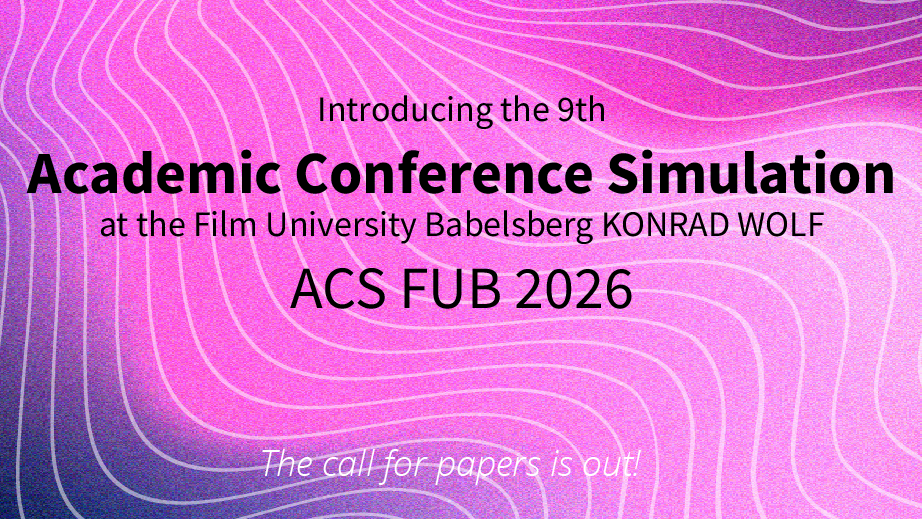
As a practical exercise for scientific research processes, there will be a conference simulation at the end of this course. This simulation replicates a typical process of submitting a research paper to a conference (or a journal) and presenting your work. Through this conference simulation you apply the lecture topics directly. The simulation includes:
- The submission of a (short-) paper
- Writing and receiving reviews
- The presentation of your work in front of your peers
- A best paper award
The Paper
The paper must adhere to an academic format (e.g. introduction, contributions, related work, problem statement, solution, future work) and it should make an academic contribution as much as possible. You should aim for a paper that we might later on submit to a real academic venue.
Topic
You can write about any topic of your choice within the field of Creative Technologies. Research questions can for example relate to your 1st term project or Bachelor thesis. The research itself does not need to be a new task. I highly recommend to try to come up with a topic in the context of your 1st term project as you have already put in a lot of thought and effort into it and it might have a greater chance of publication with an accompanying practical implementation. There are plenty of more practical and / or artistic oriented venues.
AI Tools
You are allowed to use any tool you want but must document your usage (which tool, including its version was used for what?) in the Acknowledgement Section of the paper.
However, reflect on when it makes sense to utilize a tool and when not. Within the class you should learn academic thinking and writing (and not “how to use an AI tool”).
Also, in academic contexts, the use of AI Tools gets more more strictly regulated. For example, the EuroVis conference has the following rule for paper authors:
Generative AI tools may not be used to generate scientific content or text. Limited use for grammar correction, language polishing, or rephrasing is permitted, but must be acknowledged in the Acknowledgement Section of the paper with a clear description of purpose and manner of use (e.g., “We used [tool name] solely for grammar correction and language polishing.”).
For this class, I personally recommend that you stay away from any AI help. This will be hard but a valuable and maybe even necessary learning experience.
Format
The paper must follow the format guidelines otherwise it is not accepted.
- 4-6 pages (without references)
- In English
- Abstract of <= 150 words
- Written with the given LaTeX Template
- Adhere to an academic format (e.g. introduction, contributions, related work, problem statement, solution, future work)
Submission
- You only submit a pdf version of your paper.
- Submissions will be made electronically through the EasyChair submission system. The submission will be open soon.
- Submissions are anonymous. DO NOT INCLUDE YOUR NAME IN THE SUBMITTED PAPER PDF.
- Submissions are only accepted as pdf from the given template.
Reviews
- Reviews evaluate the content but also form and language of your paper
- There will be a review template
- You will receive at least two reviews for your paper
- You will write two reviews for other papers
- Reviews will be made electronically through the EasyChair system. You will be notified by email once the review forms are available to you and you can start the review.
- You are required to use the review template given in the EasyChair system (link to be added).
The reviews might give revisions and these must be considered in the final camera-ready version. Only the camera-ready version of your paper includes your name.
Presentations
- Your presentation must be 20 minutes.
- After each presentation there will be about 10 minutes for questions from Lena and 10 minutes for questions from the audience.
Presentation Schedule
| Time | Presenter | Topic |
|---|---|---|
Deadlines
All deadlines (all dates 20:00 GMT) are hard. Late submissions are not accepted.
- 01.07.26: Submission opens
- 25.09.26: Abstract Due
- 30.09.26: Paper Due
- 02.10.26: Review Start
- 16.10.26: Review Due
- tba: Author Notification
- 12 and 13.11.26: Conference